Now that you have completed this study session, you can assess how well you have achieved its Learning Outcomes by answering these questions.
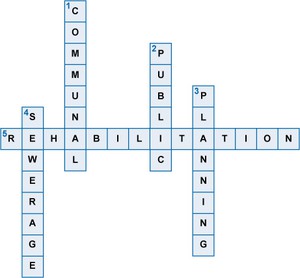
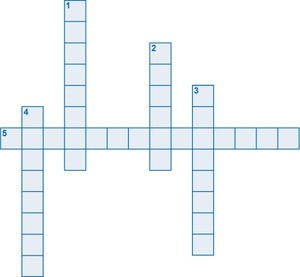
Complete the crossword below by answering the across and down clues.
Across
5. Restoring a non-functional water scheme to an efficient working condition by repair or construction methods.
Down
1. Latrines that are shared by a group of households in a community.
2. Latrines that are open to anybody, in public places or in residential areas; typically with a charge for each use.
3. A process through which we decide objectives and activities, with their sequences and resources.
4. The network of underground sewer pipes in a town or city.
Show answer
Read the following paragraph and answer the questions below.
OWNP is the Programme of the Government of Ethiopia to achieve the targets stated in the GTP, i.e. 98.5% access for water supply and 100% for sanitation. It requires US$2.41 billion. The two phases for its full implementation originally planned were Phase 1 from 2013 to 2015, and Phase 2 from 2016 to 2020. Among the modalities to achieve the targets are CMP, WMP, NGO-managed project, self-supply, CLTSH and sanitation marketing. All WASH sector ministries and regional, zonal and woreda WASH bureaus and offices are responsible for the implementation of the Programme in all regions across the country.
- What is the goal of the Programme?
- What was the original schedule in which it will be accomplished?
- Where will the plan be implemented?
- Who will implement the Programme?
- What activities will contribute to reaching the goals?
- What is the financial resource allocated for reaching the goals?
Show answer
- The goal is 98.5% access for water supply and 100% for sanitation.
- Phase 1 from 2013 to 2015 and Phase 2 from 2016 to 2020.
- Across the country.
- All WASH sector ministries and regional, zonal and woreda WASH bureaus and offices.
- CMP, WMP, NGO-managed project, self-supply, and CLTSH and sanitation marketing.
- US$2.41 billion.
Based on the data in Tables 14.1 and 14.2, approximately how many people in Dire Dawa are expected to benefit from:
- shallow boreholes with submersible pumps?
- shallow boreholes with hand pumps?
- deep boreholes with piped schemes?
Why might it not be appropriate to add together these three figures to give a total number of beneficiaries?
Show answer
In Dire Dawa region, the estimates are that:
- 32 shallow boreholes with submersible pumps will serve 32 × 1500 = 48,000 people
- 5 shallow boreholes with hand pumps will serve 5 × 500 = 2500 people
- 3 deep boreholes with a piped scheme will serve 3 × 3500 = 10,500 people.
The total number for these plans is 48,000 + 2500 + 10,500 = 61,000. However, some people could benefit from having access to more than one scheme and be in more than one group, so if you just add the totals together those people would be counted more than once.
What are the key differences between the two OWNP stages of planning: Core Plans and Annual WASH Work Plans?
Show answer
Core Plans includes physical and financial plans and oversight, providing the basis for building detailed Annual WASH Work Plans. Physical plans describe the work to be done and financial plans describe the costs and budget allocation.
Annual WASH Work Plans includes specific details of activities, assignments, schedules and proposed expenditure from all sources.
Based on Figure 14.5, what are the relative proportions of OWNP budget allocation to water supply, to sanitation and to other components?
Show answer
According to Figure 14.5, just under three-quarters of the budget is allocated to combined rural and urban water supply, just under a quarter to rural and urban sanitation and the remaining tenth (approximately) to programme management and capacity building.